
What's In My Jar
Most of us with autoimmunity are on medications that wreck gut balance — immunosuppressants, NSAIDs, steroids, antibiotics cycling in and out. The microbiome takes the hit quietly, and the symptoms get blamed on the disease instead of the disruption.
Medications don't just suppress immune activity — they deplete the nutrients and gut flora that support it. → Drug-Nutrient Depletions — AAFP
Fermentation is one of the cheapest, most direct ways to push back.
Research links gut dysbiosis to the onset and progression of autoimmune conditions — including RA, lupus, and POTS — with disrupted microbial balance affecting immune regulation at the cellular level. (Frontiers in Immunology, 2024 / NIH/PMC)
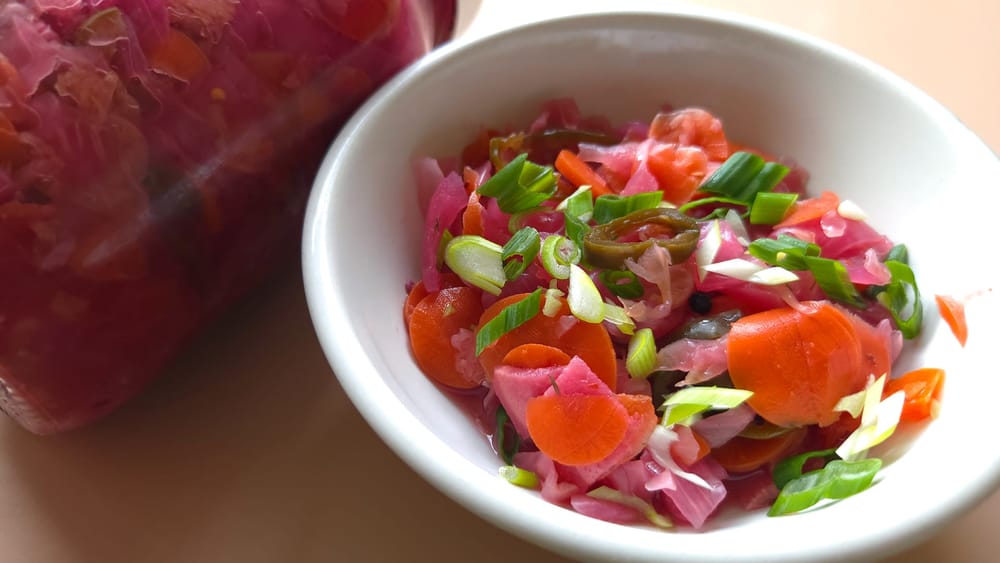
My ferment delivers: live probiotics to repopulate what medications strip, fiber to feed what survives, vitamin C, and sulforaphane — a cruciferous compound that acts as a precursor to glutathione, the body's primary antioxidant, with documented effects on inflammation and Nrf2 pathway activation. (NIH/PMC — sulforaphane and glutathione / sulforaphane and autoimmune T-cell modulation)
Not a cure protocol. A floor-raiser. Relatively economical, no prescription required.
One caveat: Fermented foods are high in histamine. If you react to aged cheeses, wine, or vinegar, start cautiously — histamine intolerance overlaps significantly with mast cell activation and some autoimmune conditions. I don't have that issue, but I'd rather name it.
Wicked Kraut (scaled for normal humans)
Not traditional. Loosely inspired by Curtido — the Salvadoran cabbage side — built for color, complexity, and actually wanting to eat it every day. A friend saw the color (from red cabbage) and said "wicked." The name stuck.
Method: Two groups prepared separately, optional third for heat. Group 1 hand-crushed with salt to release liquid. Groups 2 and 3 folded in gently — crushing kills the texture.
Crush less for crunch, more for soft. Slice coarse for crunch, thin for softer. I go minimal crush, coarse slice.
Salt: 2.0% of total weight. Weigh everything, don't guess. If you need more liquid to submerge, brine at 2.0% salt to water weight. Spring water only — tap can stall or kill fermentation.
Yield: Roughly 2–3 tall mason jars. Make what you'll eat.
Group 1 (hand crush with salt)
- 1 large cabbage — red (or green, if you prefer)
- 3 carrots, grated or sliced to preference
- 3-4 garlic cloves, de-germed, coarse dice or smashed
- 5–6 whole peppercorns
- ¼ tsp whole cumin seed (any more will totally over-take flavor profile)
- ¼ tsp sage (dried)
- ¼ tsp thyme (dried)
- ¼ tsp dill (dried)
- ½ tsp garlic powder
- 1 tsp onion powder
- 1 bay leaf, large, whole
- Salt to 2.0% of total weight
Group 2 (mix gently, fold into Group 1)
- 1 large red or orange bell pepper
- 2 green onions
- 1 large onion, sliced to preference
- Salt to 2.0% of total weight
Group 3 — Optional Heat (mix gently, fold in last)
- 1 tsp Aleppo red pepper flakes
- 3-4 jalapeños, sliced to preference (seeded, unless want it really hot)
- 4-6 finger-size pieces fresh ginger, peeled and sliced
- Salt to 2.0% of total weight
Learn the technique
→ Sauerkraut Tutorial — Joshua Weissman
→ The Guide to Lacto-Fermentation: How To Ferment Nearly Anything
Further Reading
→ Common Drug Classes, Drug-Nutrient Depletions & Drug-Nutrient Interactions — American Academy of Family Physicians / Pharmavite. Full reference chart: drug categories, what they deplete, suggested supplementation. Useful if you're on multiple medications and trying to understand what's being stripped.
→ Gut Dysbiosis and Autoimmune Disease — Frontiers in Immunology, 2024
→ Gut Microbiome and Autoimmunity — NIH/PMC
→ Sulforaphane and Glutathione — NIH/PMC
→ Sulforaphane and Autoimmune T-Cell Modulation — PubMed
← Back to Trail Provisions
* Peer reflection, not medical or nutrition advice. Your body is yours — what works for me may not work for you. *
Member discussion