Survival Settings
We're Not Broken. We're Adapted.
What if the things your body learned to do to keep you safe never got the message that the danger had passed?
Whether we had love or lacked it, many of us grew up vulnerable, facing more than our bodies and minds could make sense of. So the body learned early how to brace, how to stay quiet, how to stay ready.
Not because we were broken. Because we were human, doing the best we could with what we had.
Some adaptations we remember.
Others live quietly in the body, in patterns we don’t always understand.
Quiet Dangers
It isn’t always the headline stories of abuse, violence, or catastrophic loss. Sometimes it's the quiet, persistent things. Being misunderstood, shamed for needing, left to manage too much alone.
Your nervous system doesn't measure or compare. It responds to what it experiences.
The body that learned to brace during years of criticism can adapt just as completely as the body that survived a devastating event. There's no hierarchy of worthy pain here. If something shaped how you learned to move through the world, it matters.
And when you're a kid, you have very few tools. So you adapt.

You learn to shut up, show up, be good. You disappear, control, rebel, overachieve. You learn whatever the hell it takes, just to survive.
Those strategies work, until the cost gets too high.
The ACE Study showed this clearly: early adversity shapes biology, immunity, and long‑term health.
→ CDC-Kaiser ACE Study
Growth Rings
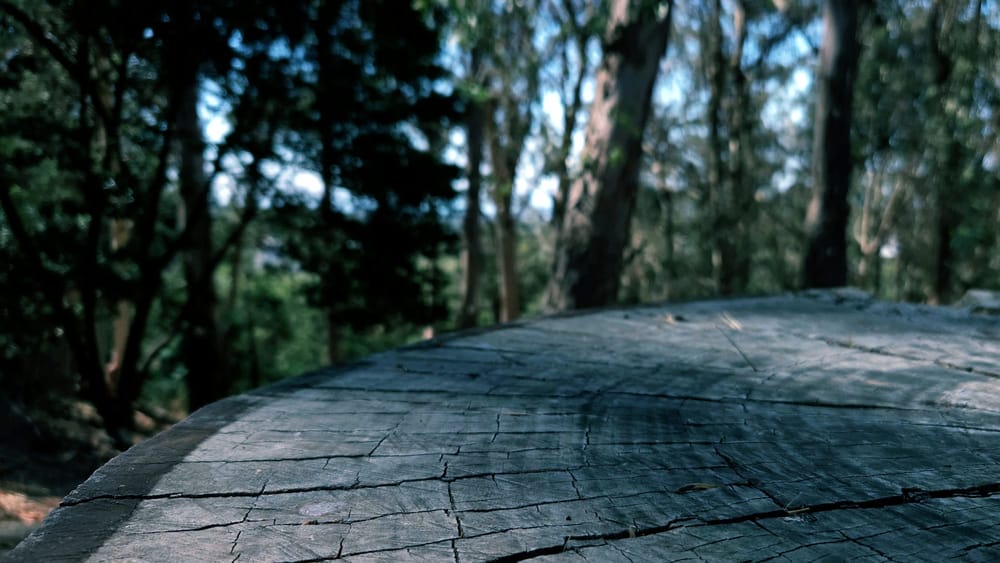
A scarred tree still grows, but its shape is different now. We grow around what happened.
Our coping strategies are growth rings formed in hard years. The people‑pleasing, the control, the retreat, the endless proving. They were smart, even brilliant, once.
They helped us navigate what we couldn’t otherwise control. But they were built for survival, not freedom.
If the world changes and the response doesn’t, the adaptation becomes something we carry everywhere.
Adaptation wasn't bad, the context just changed.
The Hum Underneath
There's a low hum beneath everything else for many of us.
Safety. Enoughness. Trust.
We stay alert, brace for what might happen, anticipate other people’s needs. Scanning the room, or staying busy enough that we never have to stop. Never feeling what’s underneath.
We get so damn good at surviving, we forget what it feels like to actually live.

Constant vigilance takes energy. Always preparing for what might come next leaves little room for simply being.
The body may not be betraying you. It may still be responding to information it learned a long time ago.
Polyvagal Theory explains how the nervous system can get stuck in survival responses, leaving us locked out of safety and regulation.
→ Polyvagal Theory
That doesn’t explain every symptom or every illness.
It does give us another place to look.
Nature’s Version of Healing
Nature doesn’t ask a damaged tree to become the tree it would have been without the storm. It grows around what happened...
A branch finds another direction. Roots work around stone. A trunk leans toward whatever light remains.
We don’t heal by shaming the parts of us that adapted. We heal by recognizing them, meeting old survival strategies with grown‑up presence. Instead of blame or urgency.
Sometimes healing begins with noticing that a response made perfect sense once.
Even if it no longer fits the life we’re living now.
UC Berkeley researchers found that veterans and at‑risk teens showed measurable improvement in PTSD and stress after nature experiences.
The Shift
When we understand what we were protecting ourselves from, we can ask a different question. Not what’s wrong with me? But what was this response trying to do for me?
We’re not broken. We’re adapted. And adaptation can be updated.
Your body may not be failing you the way it feels. It might still be working with information from an earlier time. Using strategies that made sense when you had fewer choices and fewer resources.
Understanding that changes how to approach chronic illness, chronic pain, and nervous system dysregulation. Perhaps not as enemies to defeat, but as experiences worth listening to.
The goal isn’t to erase who we became to survive. It’s to learn what no longer needs to be carried.
Growth rings don't apologize for the year that made them..
You don't have to erase what kept you alive to stop carrying it.
→ Share this with someone who never got the memo that it's safe to put it down.
Connective Tissue:
→ Everything at Once
→ Before There Were Practices
Trail Crossings & Waypoints:
→ Foundational Trailcraft
→ Oh, theWater
Outlooks & Vantages:
→ 2026 Wildflower Gallery: March
→ Blue and Gold
More on the way → Subscribe free for new posts delivered by email.
← Back to Inner Trailcraft
* peer reflections: not medical or therapy advice. *





Member discussion