Adaptive Trailcraft: The Urban Pivot

Only made it a hundred yards up the trail this morning. Not a flare, not pain in any one place. Just the specific absence of capacity, no warning or pattern. A hundred yards, and the read was clear: not today, not this.
I turned around, got back in the rig, and drove to the urban park. Went a couple of easy miles.
Somewhere in the middle of that walk, this post materialized.
The Boxes
Some mornings I sit in the parking lot before I drive home. Just sit. Because I know what's coming — the engine noise, the road noise, the merge back into traffic. I've been out long enough that my nervous system stopped bracing, and now I'm about to voluntarily walk it back into the assault.
Modernity is a series of boxes. We wake up in a box, drive a box on wheels, arrive at a larger box and live there for eight hours or more. Under the jagged flicker of fluorescent lights and the relentless low-frequency hum of appliances. The boxes contain and demand most of our waking attention, it's dulling our awareness...
We stop noticing because we never leave long enough to feel the contrast. Box Life starves the brain of the neurochemistry it needs for resilience. It's a 24/7 audio-visual assault, it makes healthy people sick and sick people worse.
For those of us navigating the chaos of Lupus, RA, POTS, IIH, CPTSD, or whatever the challenge may be, this isn't a matter of inconvenience. A body already managing systemic failure and or trauma doesn't have the reserves to absorb it.
The urban park is the exit from that siege. Not Nature Lite. A tactical ceasefire.
There's plenty of science behind this, nervous system regulation and sensory input. I don't think I need to cite them here...
You don't need peer-reviewed studies to confirm what your body already knows.
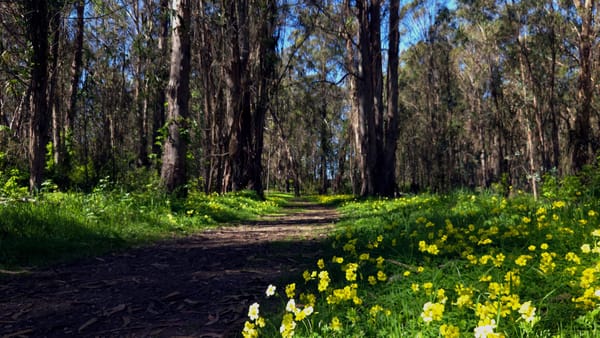
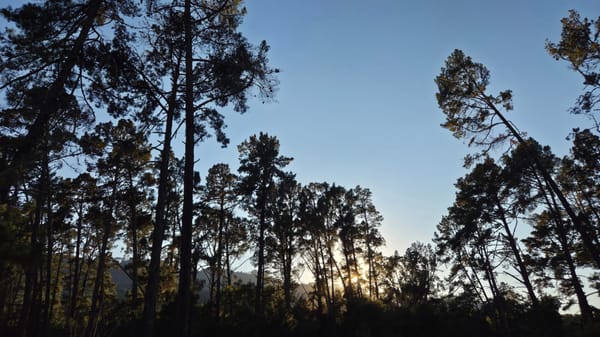
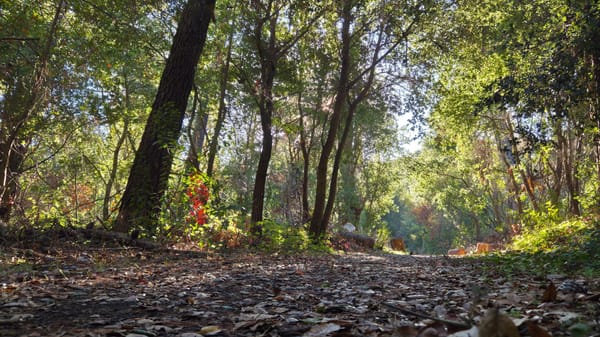
The moment you hit the grass or settle under a canopy of trees, the noise floor drops. The nervous system stops bracing for the city's mechanical drone and finally exhales.
That shift isn't a practice or a discipline. It's a biological requirement, and your body has known it longer than you've had words for it.
The Connection

In the boxes, we're isolated. On paths or trails, the walls between people soften.
I've written about M before. She has advanced osteoporosis on top of high-pain RA. The route we share gains 1400 feet in the first mile and doesn't relent — uphill both ways, out and back, just over five miles of rolling ridgeline with a few short sections to catch your breath. She does it six days a week. Not on good days. She stopped waiting for good days a long time ago.
When the climb gets hard and the breathing follows, she raises her arms like she's embracing the sky, looks over, smiles, and says: this is life, Francisco!
She knows that's not my name. It's a joke — she thought it was for the first few miles the first time we walked together, and I didn't correct her fast enough. Now it's just ours.
Still finding something worth smiling about on the way up.
We're not out there commiserating or performing wellness at each other. That moment, that smile on a 1400-foot climb from people that have every reason not to be there?
That's not small talk. That's survival talk. A confirmation that you're not the only one out here, still paying whatever the trail asks.
Tactical Recon: Nobody Gets Left Behind
The fears are real. What if I flare mid-route? What if I fall and nobody sees me? What if the terrain is nothing like the listing said? When your body is already managing a complex system, an unplanned barrier isn't a minor inconvenience. It's a full abort.
But we're not operating in an information vacuum anymore. Apps like AllTrails let you filter for paved surfaces and wheelchair-friendly routes. Google Street View lets you walk the path virtually before you leave. Grades, bench locations, parking, surface conditions, curb cuts, bathroom access, all checkable before you've laced anything up.
The reconnaissance is available. Use it. Knowledge is the equipment that keeps you in the game.
There are also meetup groups, local pages, and adaptive hiking communities for almost every interest and mobility level. A lot of them are rolling with their own invisible gear. Showing up to a group walk isn't committing to a PCT thru-hike. It's testing new exit strategies: that are safer, supported, and built for people who know the terrain of flare-land.

Resources:
AllTrails: A trail finder that lets you filter for paved, wheelchair‑friendly, and low‑effort routes, plus crowd‑sourced notes on stairs, curbs, and rough patches.
Google Maps + Street View: Maps your walk with wheelchair‑accessible routes where available and lets you preview curb cuts, benches, and terrain before you leave.
TrailLink: Focuses on rail‑trails and multi‑use paths, many of which are flat, paved, and tagged as wheelchair‑accessible.
WheelMap: A crowdsourced map showing wheelchair‑accessibility of parks, restrooms, and public spaces, so you can plan accessible entry and exit points.
AccessNow: Rates cafés, venues, and public spots by accessibility, helping you pair an easy trail with an accessible place to rest.
Meetup: Local walking groups, adaptive hikes, and wheelchair‑friendly meetups that reduce the “going alone” load.
Controlled Environment, Real Gains
When capacity is a moving target, the urban park offers something the backcountry can't: predictability. The terrain isn't going to surprise you with steep and loose when your joints are already in negotiation.
A bench every hundred yards isn't a concession to weakness. It's a tactical asset that extends your range. The sensory input, green and dappled light and ambient sound that isn't machinery, delivers what your nervous system is starved for without the physical payment a high-exertion day demands.
For a body managing multiple systemic variables, control isn't a limitation. It's the whole point.
The Pivot
I don't go to these spaces to find myself. I go to stop the bleeding of my nervous system.
Choosing a wooded city park on a rough day isn't settling. It's reading the mission correctly. It's the decision to protect your aliveness instead of spending it at a price you can't afford to pay tomorrow.
We live in the boxes. We don't have to stay in them until we break.
Pivoting. It's how we keep rolling.
Safety Note
This is my individual, personal experience, not medical or therapy advice. If something spikes pain or panic, stop. Stabilization beats bravado. Work with a practitioner who respects your pace.
← Back to Adaptive Trailcraft

Member discussion